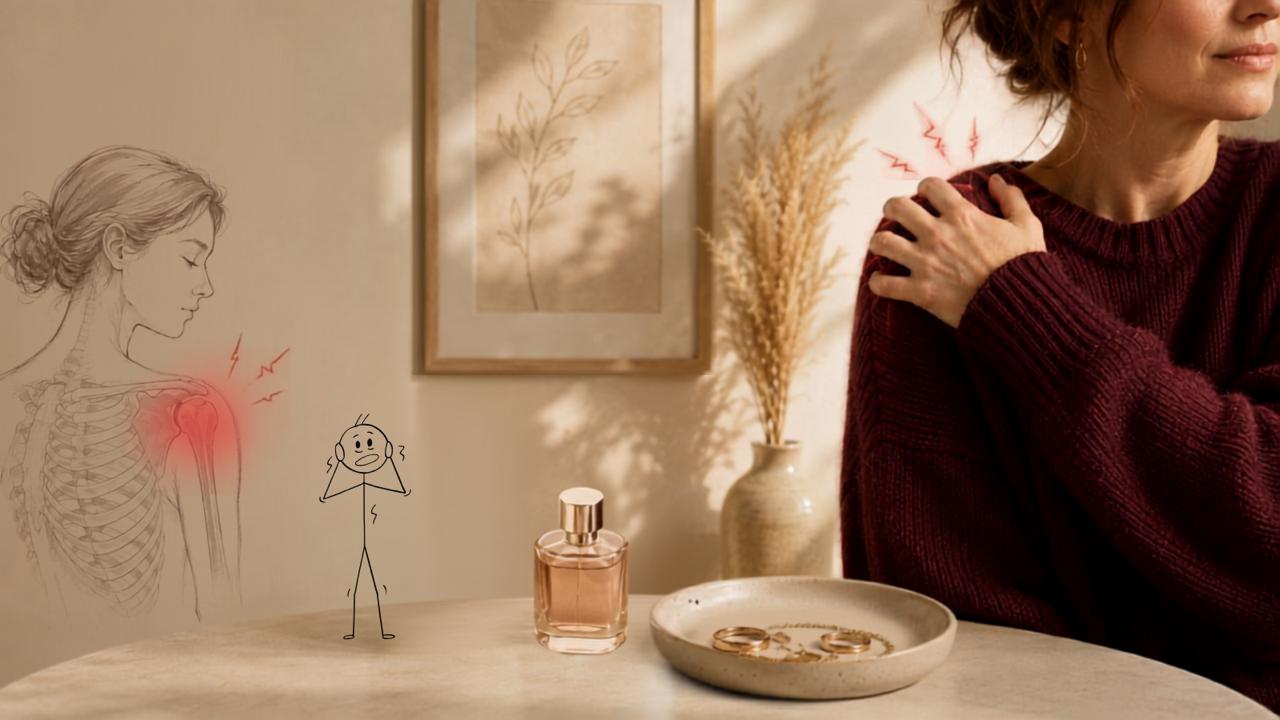
Many women experience frozen shoulder during perimenopause, often without realising the two may be connected. This is one of Maggie's Lost Pages.
It was early on a Saturday morning, and the Sullivan household was quiet.
It simply started with a sweater.
Nothing dramatic like a marathon.
Not CrossFit.
Not helping someone move house.
It was a simple sweater.
One arm slipped through the sleeve without incident.
The other behaved as though I'd asked it to solve world peace.
I tried again.
Nothing.
I twisted.
I leaned.
I rotated.
I briefly considered taking the sweater off and introducing myself again.
That was when Dan wandered past.
"Everything alright?"
"Absolutely."
I was standing in the bedroom wearing one sleeve, the rest of the sweater wrapped around my waist, with my
left arm pointing towards the ceiling like I was attempting to hail a rescue helicopter.
He watched for a moment.
"Umm, Do you need a hand?"
"No." I replied stubbornly
Another twenty seconds passed.
"...Maybe."
Without saying a word, he gently pulled the sleeve over my arm.
"There."
I thanked him.
Then immediately became offended.
Not at Dan.
At my shoulder.
Late forties is the stage of life where body parts could quietly resign without giving notice.
The sweater was only the beginning.
Reaching for the seatbelt now required strategic planning.
Washing my hair had become an engineering exercise.
The top supermarket shelf had quietly become somebody else's responsibility.
Fastening my bra deserved Olympic level gymnastics.
Nobody warns you about this part.
Everyone talks about hormones.
And everyone else, talks about hot flushes.
Nobody mentions that one shoulder may suddenly decide that overhead movement is no longer aligned with its life goals.
The strange thing is it creeps in slowly and then wham! ...
The pain isn’t excruciating at first, or maybe it is. Well it depends entirely on your pain threshold.
Then the shoulder becomes stubborn.
Like a teenager being asked to unpack the dishwasher.
In my case, my shoulder simply refused to behave.
So I eventually stopped arguing with it.
Mostly because it was winning.
These days I choose my clothes based on whether they'll cooperate with my shoulder.
Fortunately... the sweater and I are speaking again.
Truth Bite
Frozen shoulder (adhesive capsulitis) is surprisingly common during perimenopause and menopause.
While the exact cause isn't fully understood, declining estrogen is thought to affect connective tissues and inflammation, making women in midlife significantly more likely to develop it.
Everyday activities such as dressing, reaching overhead, fastening a bra or washing your hair can suddenly become difficult.
The good news is that frozen shoulder usually improves over time. Physiotherapy, gentle movement and appropriate medical advice can all help during recovery.
You're not alone.
If you've ever lost an argument with a sweater, Maggie completely understands :-)
Comments
No responses yet. Be the first to respond.